HYDRAA Flags STP Water Quality Concerns During Nallagandla Inspection
 WhatsApp Channel
Location: Nalgandla, Cyberabad
PJNews | Nallagandla, Hyderabad | November 21, 2026 : The Hyderabad Disaster Response and Asset Protection Agency (HYDRAA) has called on gated residential communities to operate their sewage treatment plants effectively and reuse treated wastewater instead of placing unnecessary pressure on groundwater resources.
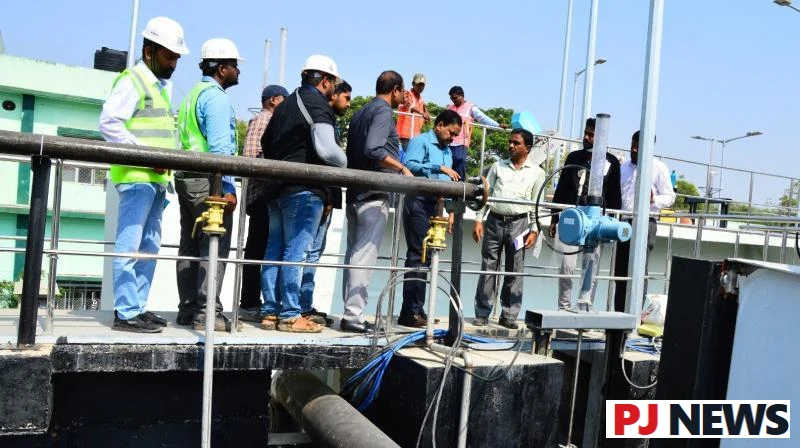
The direction followed an inspection by HYDRAA Commissioner A.V. Ranganath on Friday, November 20, near Nallagandla Lake in Hyderabad's western suburbs.
Get important news and breaking updates directly.
After reviewing development work at the lake, Ranganath visited a sewage treatment plant (STP) at a nearby gated community.
Officials examined how sewage was collected, processed and reused, and whether treated wastewater was being discharged appropriately.
The inspection raised concerns about the quality of water leaving the residential STP.
According to preliminary online measurements reported by HYDRAA, the biochemical oxygen demand (BOD) in the treated wastewater was 25.5 milligrams per litre.
This was higher than the 20 mg/L limit identified as applicable in Hyderabad in the officials' preliminary findings.
BOD indicates the amount of oxygen required by microorganisms to break down biodegradable organic matter in water. Elevated BOD can indicate that wastewater contains a greater organic pollution load or requires further treatment.
The preliminary tests also recorded turbidity of 20.81 nephelometric turbidity units (NTU) and dissolved oxygen (DO) of 0.66 mg/L.
Turbidity measures the cloudiness of water, while dissolved oxygen indicates the amount of oxygen present in the water.
Officials said the results warranted closer examination of the membrane performance in the plant's membrane bioreactor (MBR) treatment system.
Additional samples were collected and sent to the Telangana Pollution Control Board for laboratory analysis.
The final laboratory findings will be important in determining the STP's treatment efficiency and whether any environmental compliance action is warranted.
The available information does not establish that a final violation finding, penalty or prosecution has been issued against the inspected residential community.
During the visit, Ranganath instructed gated community managements to use their STPs fully and reuse treated water for appropriate non-potable activities, including landscaping and gardening.
He said residential complexes should not discharge reusable treated wastewater while continuing to extract large quantities of groundwater through borewells.
He also stressed that sewage must undergo adequate treatment before entering drainage channels or water bodies.
The issue is particularly significant in rapidly developing residential neighbourhoods where apartment complexes rely on borewells and water tankers while generating substantial quantities of wastewater.
Reusing properly treated wastewater for suitable non-drinking purposes could reduce the demand for freshwater and help conserve underground reserves.
The broader challenge is reflected in a 2025 study cited by The Times of India on November 19. The study estimated that Hyderabad reused approximately 27 million litres per day (MLD) out of 772 MLD of treated sewage, or about 3.5 per cent.
Those figures are historical study estimates and should not be confused with the Water Board's latest operational data, which cover a different period and scope.
The Nallagandla inspection also underlines the importance of ongoing monitoring after STPs are installed in residential projects.
An STP's existence alone does not guarantee that it is operated properly, maintained consistently or producing water suitable for its intended reuse.
The identity of the inspected complex, its specific consent conditions, the complete laboratory report and any subsequent regulatory directions have not yet been independently verified.
For residents, the immediate questions concern the safety and suitability of treated water, the transparency of testing and whether residential managements maintain reliable operational records.
PJNews will seek the Pollution Control Board's laboratory findings, the applicable discharge and reuse standards, and HYDRAA's follow-up inspection details.
Get the latest stories and breaking news on WhatsApp.