


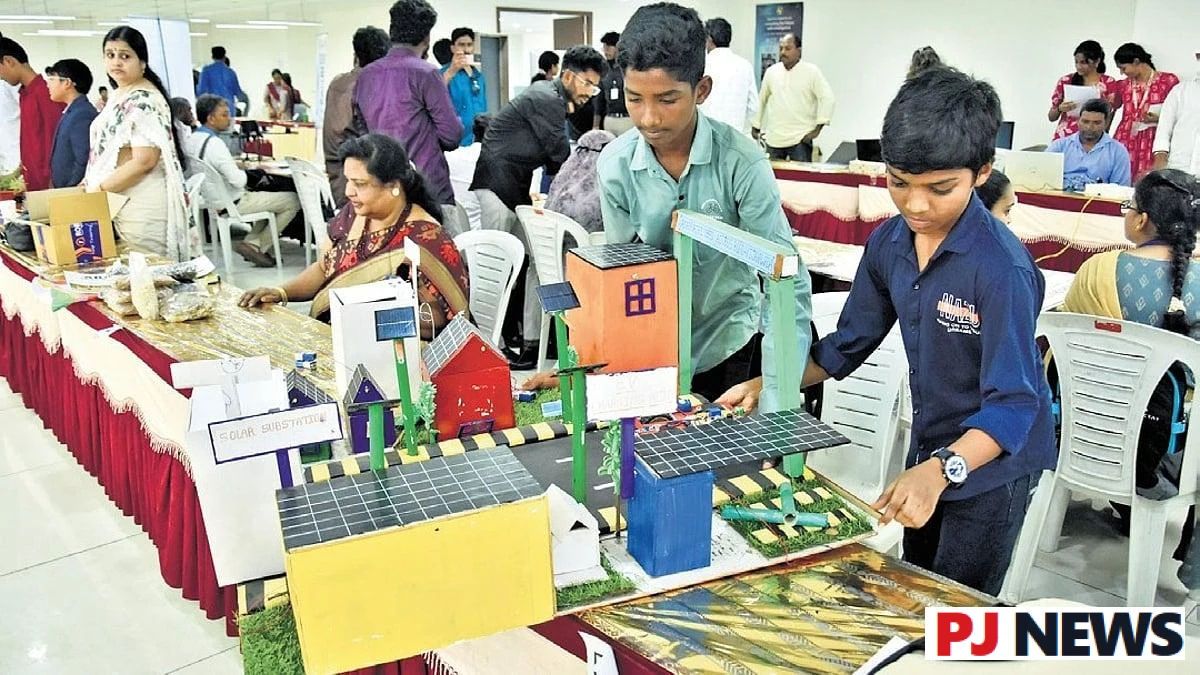
- State-level exhibitions scheduled for December 10 and 11 to encourage innovation among students
Amaravati: Schools across Andhra Pradesh are scheduled to begin science fairs on November 23 as part of an initiative by the School Education Department to encourage scientific thinking, creativity and innovation among students.
The department has announced a programme of competitions at school, mandal, district and state levels for the 2026–27 academic year.
The exhibitions will be organised under the theme “STEM for Viksit and Atmanirbhar Bharat,” highlighting the role of science, technology, engineering and mathematics in addressing everyday challenges.
Students will have opportunities to present projects covering artificial intelligence, green energy, environmental protection, mathematical modelling, healthcare, sanitation, indigenous agricultural practices, disaster management and rural development.
According to the tentative schedule, school-level competitions will take place on November 23, followed by mandal-level exhibitions on November 25.
District-level competitions are scheduled between November 28 and 30, while the state-level science fair will be held on December 10 and 11.
The programme also includes competitions under the Southern India Science Fair 2027, covering eight disciplines such as physics, chemistry, mathematics, earth and space science, environmental science, engineering, bioscience and computer science.
Students studying in Classes VIII to X will be eligible for the Southern India Science Fair category.
Each district will select seven exhibits for the state-level competitions, including three group projects, two individual student projects and two teacher projects.
Headmasters will coordinate school-level exhibitions, while mandal education officers and district science officers will supervise subsequent rounds.
The department has directed officials to encourage broad participation, maintain transparency in judging and follow uniform evaluation procedures.
The initiative is expected to provide students, particularly those from rural schools, with opportunities to demonstrate practical scientific ideas and develop problem-solving skills beyond classroom learning.